Saphenion®: Schicksale der Stammvenen – The fate of truncal veins

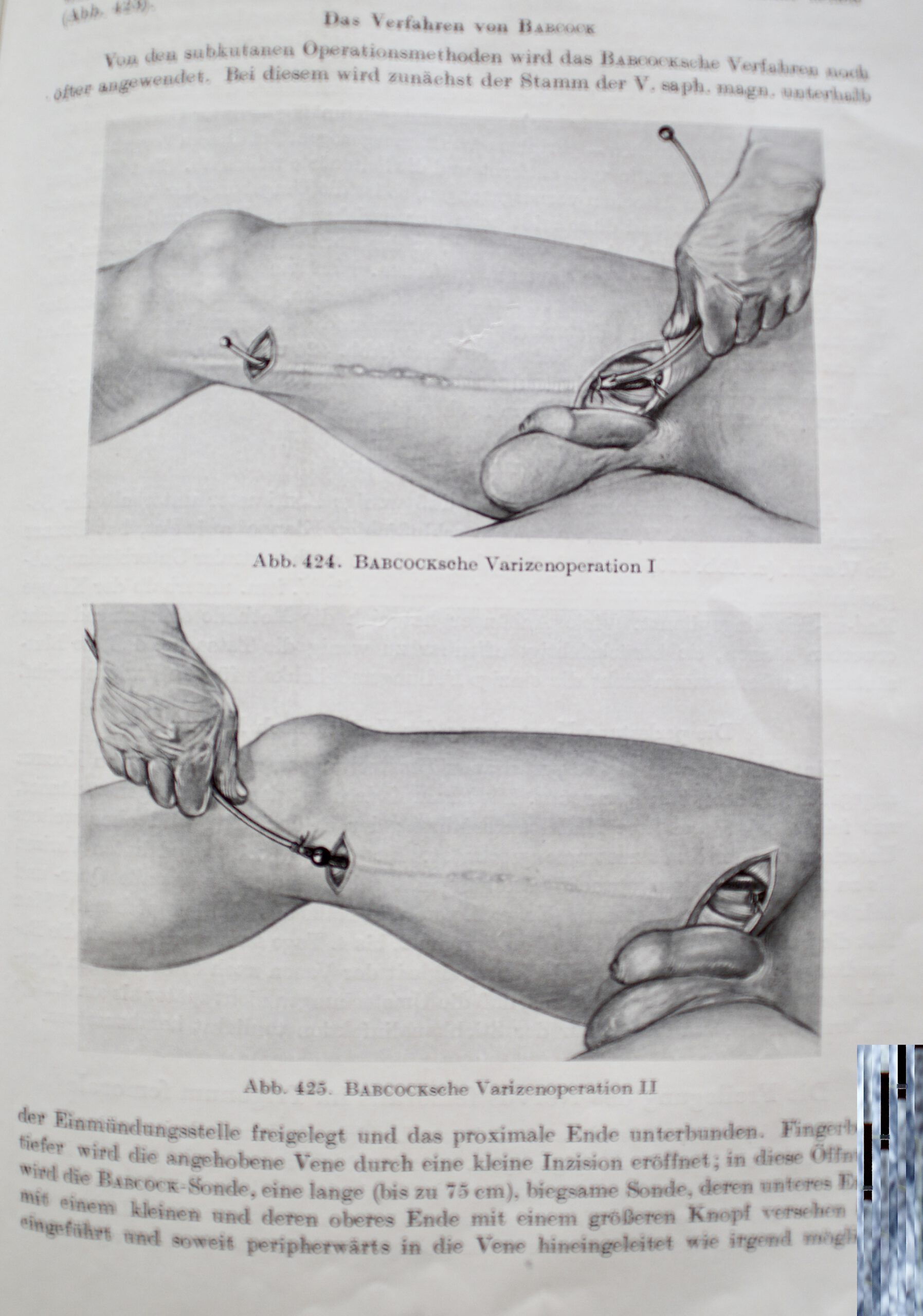
Nahezu exakt 61 Jahre ist es her, als mein Freund und Kollege Privatdozent Dr. Wolfgang Lahl als Assistent die Chirurgische Klinik im Berliner Polizeikrankenhaus betrat. Sofort war er als junger Assistent mit der Betreuung der Venenpatienten betraut, denn kein älterer erfahrenerer Kollege wollte diese Aufgabe gerne übernehmen.

Von gleicher Erfahrung kann Dr. Ulf Th.Zierau berichten – 25 Jahre später an der Charitè in Berlin. Kaum als Assistent eingesetzt, waren es die Venenkranken. In dieser Zeit wurde die Venenchirurgie ausschließlich stationär betrieben. Die Patienten waren in aller Regel für 7 Tage hospitalisiert. So lernten wir beide – fast ein Viertel Jahrhundert auseinander jeweils das Schicksal der Vena saphena kennen.
It was almost exactly 61 years ago that my friend and colleague Privatdozent Dr. Wolfgang Lahl joined the Surgical Clinic at the Berlin Police Hospital as an assistant. As a young assistant, he was immediately entrusted with the care of vein patients, as no older, more experienced colleague wanted to take on this task.

Dr. Ulf Th. Zierau can report the same experience – 25 years later at the Charitè in Berlin. As soon as he was appointed as an assistant, it was the vein patients. At that time, vein surgery was performed exclusively on an inpatient basis. Patients were usually hospitalized for 7 days. This is how we both got to know the fate of the saphenous vein – almost a quarter of a century apart.

Saphenion®: Krampfadern und AntibabyPille

In der Literatur finden wir eine Vielzahl von verschiedenen Angaben zum Risiko der Krampfaderentstehung bei einer bekannten Familienanamnese. Eine positive Familienanamnese ist sowohl bei Männern (80%), als auch bei Frauen (95%) mit Krampfadern häufiger als bei beiden Geschlechtern ohne die positive Familienanamnese. Die Häufigkeit der Krampfaderentstehung ist bei Männern jedoch deutlich weniger mit einer genetisch bedingten Familienanamnese verbunden, als bei Frauen. Es ist inzwischen sicher, dass es eine erbliche Komponente von Krampfadern gibt, diese ist jedoch nicht allein für die Krampfaderentstehung verantwortlich. Die bereits bekannten Risikofaktoren, langes Stehen, langes Sitzen, zu hohes Gewicht usw., spielen ebenso eine wesentliche Rolle, wie auch die Hormontherapie (z. B. AntibabyPille, Brustkrebstherapie).

In the literature, we find a large number of different information on the risk of developing varicose veins with a known family history. Positive family history is more common in both men (80%) and women (95%) with varicose veins than in both sexes without a positive family history. The frequency of the development of varicose veins is, however, significantly less associated with a genetically determined family history in men than in women. It is now certain that there is a hereditary component of varicose veins, but this is not solely responsible for the development of varicose veins. The already known risk factors, standing for long periods, sitting for a long time, excessive weight, etc., also play an essential role, as does hormone therapy (e.g. birth control pills, breast cancer therapy).

Saphenion®: Rudern bei Krampfadern

Das Fitnesstraining ist in vielen Punkten eine grosse Belastung für das Beinvenensytem. Das Stemmen von Gewichten, ob auf der Stemmbank oder auch beim Gewichtheben, stellt eine enorme Druckbelastung für alle Beinvenen dar. Neben dem erheblichen Druck, der sich durch die Anspannung der Bauch – und Beckenmuskulatur in der Bauchhöhle aufbaut, kommt der hydrostatische Druck dazu.

In many ways, fitness training places a great strain on the leg vein system. Lifting weights, whether on a weight bench or in weightlifting, puts enormous pressure on all the leg veins. In addition to the considerable pressure that builds up in the abdominal cavity due to the tension in the abdominal and pelvic muscles, there is also hydrostatic pressure.

Saphenion®: Kompressionstrumpf nach Krampfadertherapie?

Saphenion®: Kompressionsstrumpf nach Krampfadertherapie? Eine post operative Kompressionsstrumpftherapie wird in zahlreichen Leitlinien der internationalen Venen – Fachgesellschaften empfohlen. Sie dient der Schmerzlinderung, der post operativen Reduzierung von Gewebeschwellung und Ödembildung, der Kompression von Blutergüssen und Wundhöhlen (nach Stripping – Op). Insgesamt also eine Maßnahme, die auf eine für den Patienten komplikationsärmere Erholungsphase (Rekonvaleszenz) nach der Therapie hinarbeiten möchte.

The Covid-19 High Noon: thrombosis – pulmonary embolism

Quote from Prof. Püschel: “First of all, we found that the causes of death are very different. There are no ‘corona deaths, as the statistics suggest,” said Püschel of the “FAZ”. Instead, there are “a lot of causes of death” in connection with the corona virus. It should be clearly stated that the previous diseases played a very important role in the course of the disease, according to the legal doctor.

Saphenion®: WendeZeit an der Charité – Elitenaustausch an ostdeutschen Kliniken

Saphenion®: WendeZeit an der Charitè – Aus Anlaß des 36. Jahres nach dem Mauerfall am 9. 11. 1989 möchten wir folgende Zeilen erneut veröffentlichen:

Saphenion®: WendeZeit an der Charitè – Die Berliner Charité, Deutschlands bekanntestes Krankenhaus, war zugleich ein Zentrum von Forschung, Lehre und Weiterbildung. Sie war Teil der Universität, welche zu DDR-Zeiten den Namen Humboldt erhielt. Nach dem Ende der DDR fand auch in der Charité ein erheblicher Austausch des Führungspersonals statt, die Medien lieferten die Begleitmusik mit Stasi-Hysterie und Skandalgeschichten. Die Charité, auch zu DDR-Zeiten national und international eine bekannte Universitätsklinik, schien nun in der öffentlichen Wahrnehmung eine Außenstelle des MfS und des Politbüros gewesen zu sein.
Saphenion®: WendeZeit an der Charitè – Berlin’s Charité, Germany’s best-known hospital, was also a center for research, teaching and further education. It was part of the university that was given the name Humboldt in GDR times. After the end of the GDR, the management staff at the Charité was also replaced, with the media providing the appropriate background music with Stasi hysteria and scandal stories. The Charité, still a nationally and internationally renowned university hospital in GDR times, now appeared to the public as a branch of the MfS and the Politburo.