Saphenion®: Gefäßchirurgie Rostock – Historisches

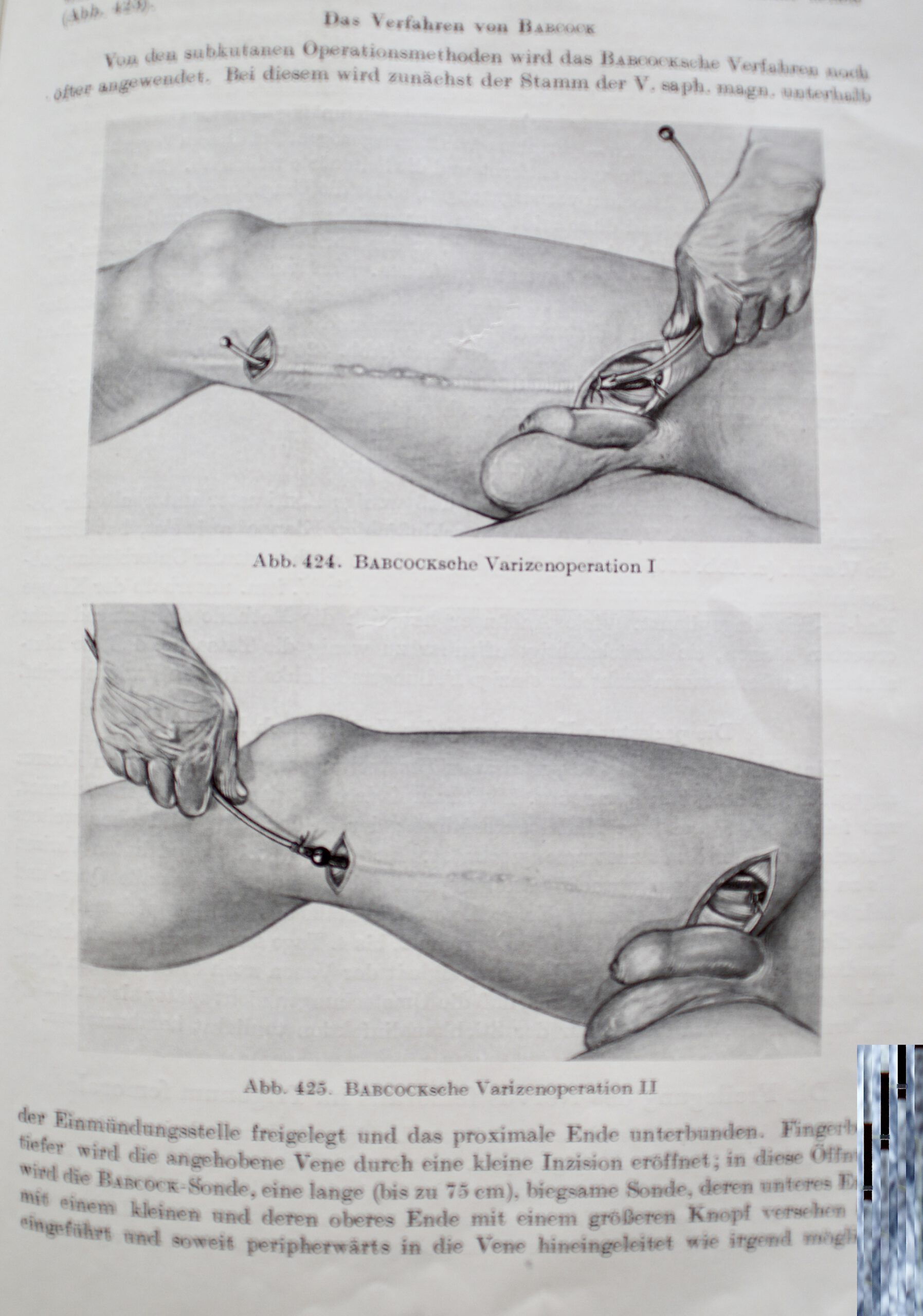
Saphenion®: Gefäßchirurgie Rostock – Historisches – Die neuzeitliche Krampfadertherapie begann mit Schede in Berlin, er entfernte ab 1866 Seitenastkrampfadern über viele Hautschnitte. In 1884 berichtete Madelung von Ausschäloperationen „zirkoider Varizen“, auch der Stammkrampfadern (Vena saphena magna).

Friedrich Trendelenburg, zuvor bis 1882 in Rostock Chirurg und Ordinarius an der Uniklinik, beschrieb 1888-1891 den – heute noch gültigen und für die Therapie maßgeblichen – pathologischen Rezirkulationskreislauf bei Krampfadern.

Saphenion®: Gefäßchirurgie Rostock – History – Modern varicose vein therapy began with Schede in Berlin, who removed side branch varicose veins through many skin incisions from 1866 onwards. In 1884 Madelung reported on peeling out operations of „circoid varices“ and the trunk varices (Vena saphena magna).

Friedrich Trendelenburg, previously a surgeon in Rostock from 1875 until 1882 and a full professor at the university hospital, described in 1888-1891 the pathological recirculation cycle in varicose veins, which is still valid today and is decisive for therapy.

Saphenion®: Deutsche VenaSeal® – MulticenterStudie

Wir wollten eine erste deutsche MulticenterStudie zur Krampfadertherapie mit dem Venenkleber „VenaSeal®“ erstellen. Mit der Erfahrung von über 8 Jahren Anwendung, mit 2988 therapierten Patienten und 5333 Stammkrampfadern als Grundlage unserer Erfahrungen.

We wanted to create a first German multicenter study on varicose vein therapy with the vein glue „VenaSeal®“. With the experience of over 8 years of use, with 2988 treated patients and 5333 truncal varicose veins as the basis of our experience.

Saphenion®: Kathetergestützte Therapie Baker-Zyste

Die Behandlung der Baker-Zyste kann entweder konservativ oder operativ erfolgen. Die konservative Therapie schließt eine antientzündliche medikamentöse Therapie (Ibuprofen, Diclofenac) und auch eine Punktion der Zyste ein. Bei der operativen Therapie wird in der Regel die gesamte Zyste über einen recht großen Hautschnitt in der Kniekehle freigelegt und an ihrer Wurzel (Kanal ins Kniegelenk) unterbunden und dann abgetrennt. Auf Grund der Radikalität des Eingriffs muss man nach der Operation mit den üblichen Komplikationen chirurgischer Eingriffe in sensiblen Regionen (Kniekehle) rechnen.
Die kathetergestützte bipolare Thermoablation (RFITT) der Baker – Zyste ist ein weltweit in nur wenigen Zentren im klinischen Einsatz befindliches Verfahren zur endozystischen minimalinvasiven Thermoablation von Kniegelenkzysten. Es wurde 2009 von SAPHENION in den klinischen Alltag eingeführt.

Baker’s cyst can be treated either conservatively or surgically. Conservative treatment includes anti-inflammatory medication (ibuprofen, diclofenac) and a puncture of the cyst. In surgical treatment, the entire cyst is usually exposed via a fairly large incision in the hollow of the knee and its root (canal into the knee joint) is cut off and then removed. Due to the radical nature of the procedure, the usual complications of surgical procedures in sensitive regions (popliteal fossa) must be expected after the operation.
Catheter-assisted bipolar thermal ablation (RFITT) of the Baker cyst is a procedure for endocystic minimally invasive thermal ablation of knee joint cysts that is in clinical use in only a few centers worldwide. It was introduced into everyday clinical practice by SAPHENION in 2009.

Saphenion®: Schicksale der Stammvenen – The fate of truncal veins

Nahezu exakt 61 Jahre ist es her, als mein Freund und Kollege Privatdozent Dr. Wolfgang Lahl als Assistent die Chirurgische Klinik im Berliner Polizeikrankenhaus betrat. Sofort war er als junger Assistent mit der Betreuung der Venenpatienten betraut, denn kein älterer erfahrenerer Kollege wollte diese Aufgabe gerne übernehmen.

Von gleicher Erfahrung kann Dr. Ulf Th.Zierau berichten – 25 Jahre später an der Charitè in Berlin. Kaum als Assistent eingesetzt, waren es die Venenkranken. In dieser Zeit wurde die Venenchirurgie ausschließlich stationär betrieben. Die Patienten waren in aller Regel für 7 Tage hospitalisiert. So lernten wir beide – fast ein Viertel Jahrhundert auseinander jeweils das Schicksal der Vena saphena kennen.
It was almost exactly 61 years ago that my friend and colleague Privatdozent Dr. Wolfgang Lahl joined the Surgical Clinic at the Berlin Police Hospital as an assistant. As a young assistant, he was immediately entrusted with the care of vein patients, as no older, more experienced colleague wanted to take on this task.

Dr. Ulf Th. Zierau can report the same experience – 25 years later at the Charitè in Berlin. As soon as he was appointed as an assistant, it was the vein patients. At that time, vein surgery was performed exclusively on an inpatient basis. Patients were usually hospitalized for 7 days. This is how we both got to know the fate of the saphenous vein – almost a quarter of a century apart.

Saphenion®: Schwere Komplikationen nach Venenkleber?

Saphenion®: Schwere Komplikationen nach Venenkleber? Veröffentlichung Thema „899 schwerwiegende Ereignisse bei Venenkleber – Therapie.

Saphenion® Rostock: Potential complications following the use of venous glue?
A recent publication has highlighted the occurrence of 899 severe adverse events associated with the use of vein glue therapy.

Saphenion®: Mikroschaum bei Rumpfkrampfadern

Krampfadern am Rumpf sind in der täglichen Venenpraxis eher eine Ausnahme. Ab und an sehen wir Krampfadern an den Bauchdecken oder im Decolletè.

Varicose veins on the torso are rather rare in everyday vein practice. Occasionally, we see varicose veins on the abdominal wall or in the décolletage area.